
Launching a development project in Dubai requires a budget of at least 100 million AED. The process involves careful site selection, which accounts for up to 30% of costs, multi-stage approvals, and strict compliance with escrow rules. To start sales, a developer must confirm 20% construction completion or provide an equivalent bank guarantee.
Key takeaways
- The minimum budget to build a residential building in Dubai is about 100 million AED.
- Land costs account for 25–30% of total project expenses.
- Land purchase negotiations take 3 to 8 months, and project approval takes another 3 to 5 months.
- Developers cannot accept money from buyers before officially opening an escrow account.
- Building one monolithic floor takes up to a month due to the climate and labor availability.
- Developers must provide a 10-year structural warranty and a 1-year warranty for defect repairs.
Strategy and land search
A successful development project in Dubai requires at least 100 million AED in capital. Preparation begins with deep analysis. Developers calculate a location's potential 5 to 7 years ahead. They evaluate transport accessibility, infrastructure, proximity to water, and district development prospects. Demographics play a crucial role in the strategy. By the end of 2024, the emirate's population reached 4,248,200 people, according to the Dubai Statistics Center. The annual growth was 256,300 residents (DSC). This influx of expats creates stable demand for new residential space.
Finding and buying a suitable plot of land is one of the longest stages. Negotiations with landowners can take 3 to 8 months. The plot cost usually accounts for 25–30% of the total project budget. Land prices depend heavily on soil characteristics, permitted building height, and parking requirements. For example, digging a deep pit for multi-level underground parking significantly increases costs compared to surface parking.
The emirate's land market remains highly active. In the first half of 2026, Dubai recorded the sale of 4,861 land plots, according to Arabian Business.
Approval process and construction standards
After purchasing the plot, the project goes through approvals. This process takes 3 to 5 months. In Dubai, the Dubai Municipality issues building permits and oversees construction. The developer must approve the architectural design, internal layouts, and engineering networks.
Transport infrastructure receives special attention. The project undergoes review by the RTA (Roads and Transport Authority), which approves entry and exit layouts, as well as the number of parking spaces tied to apartment sizes. Once final renders, facades, and interior finishes are approved, the project is locked. Making changes becomes impossible without repeating the procedures.
UAE law strictly protects property buyers. Under the UAE Civil Code and the DLD investor rights guide, the developer holds a 10-year decennial liability for major structural defects. Additionally, there is a mandatory 1-year warranty to fix minor defects and cracks caused by the building's natural settling.
Escrow accounts and financial security
A key element of investment protection in Dubai is the escrow account system, regulated by Law No. 8 of 2007. A developer has no legal right to accept payments from buyers before officially opening a dedicated project account. Violating this rule leads to heavy fines and business suspension.
To activate an escrow account, the developer must meet strict Dubai Land Department (DLD) requirements. They must confirm 20% construction completion or provide a bank guarantee for the same amount. When signing the Sales and Purchase Agreement (SPA), the buyer pays a 4% registration fee based on the property value.
The developer gains access to buyer funds in stages. To receive the next construction tranche, the developer calls for a DLD inspection. The commission checks the volume of completed monolithic, plumbing, and finishing works, then issues a technical report. Only based on this document does the bank transfer funds from the escrow account to pay for further construction. The completion percentage is also recorded in the official Dubai REST app, where any investor can track their property's status. Rules vary by emirate. For example, under Ras Al Khaimah RERA regulations, an escrow account is opened for the entire project, not individually for each apartment.
Construction speed and material selection
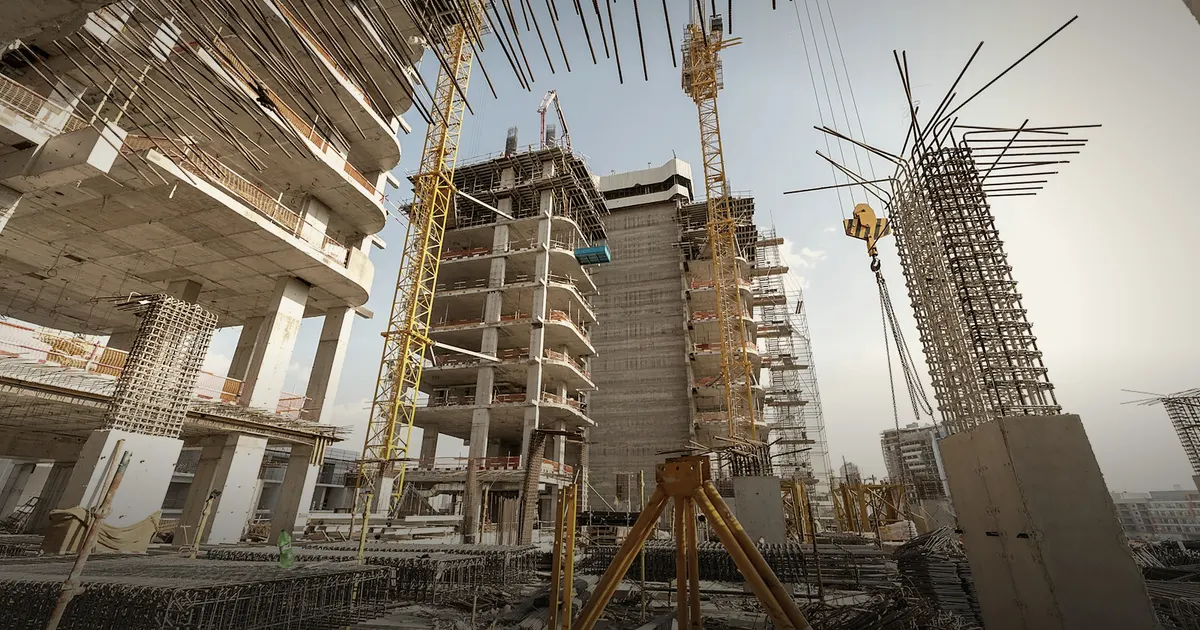
High construction speed in Dubai is driven by labor availability and favorable weather, which allows concrete to dry quickly. Building one turnkey monolithic floor with formwork and reinforcement takes a maximum of one month. Thus, the frame of a 10-story building takes about 10 months to build.
To optimize costs without losing quality, developers source materials globally. Natural stone for finishing might come from Greece or Egypt, and interior wood from India. This creates a premium product at a competitive cost, avoiding overpayment for famous European brands.
Construction speed inevitably leads to natural building settlement in the first months of use. Microcracks in the plaster are normal. Under the 1-year warranty, the developer quickly fixes these flaws, repainting and leveling walls upon the owner's request.
Property management and rentals
After the building is commissioned, complex management transfers to a specialized company. The costs of maintaining pools, gyms, gardens, and 24/7 services are fully covered by service charges. According to DLD legislation, these funds are used exclusively to pay for services, maintenance, and management of the complex's common property.
Modern residential buildings in Dubai are increasingly designed for investors renting out property. Smart home systems allow residents to pay bills remotely, order food from ground-floor restaurants, or book recreation areas. Management companies also handle short-term apartment rentals, saving foreign owners from needing to be present in the UAE. Unlike some other countries, Dubai has no strict limits on short-term rentals in residential buildings, provided the complex rules allow it.
Project economics and market situation
A developer's financial model in the UAE always accounts for the tax burden. The Corporate Tax rate, administered by the Federal Tax Authority, is 9% for profits exceeding 375,000 AED. This rule applies to real estate companies as well.
The final apartment cost is also affected by the payment plan structure. Projects with long post-handover payment plans cost the buyer more, as the developer factors the cost of holding capital into the price.
To understand project economics, one must evaluate current demand and pricing. According to YAFF calculations based on open DLD data, Dubai recorded 9,233 residential sales transactions in October 2026. The median transaction price was 1,244,912 AED (about 338,982 USD), and the median price per square meter was 18,147 AED (4,941 USD). The share of off-plan housing in total sales reached 66%.
Price comparison in popular districts
The price difference between off-plan and ready properties depends heavily on the location and the district's development stage. In established areas with a shortage of new plots, new builds sell at a significant premium to the secondary market due to modern infrastructure and flexible payment plans. Let's look at the median prices per square meter for off-plan and ready apartments in popular locations from May to October 2026:
| District | Off-plan (AED/m²) | Ready (AED/m²) | Off-plan share |
|---|---|---|---|
| Downtown Dubai | 38,084 | 26,628 | 21% |
| Business Bay | 26,594 | 19,066 | 38% |
| Meydan | 24,299 | 20,399 | 46% |
| Jaddaf Waterfront | 19,799 | 20,346 | 61% |
YAFF calculations.
Waterfront locations like Jaddaf Waterfront attract developers with ready infrastructure and park areas. The entry threshold there remains more affordable compared to central business districts, making them promising for early-stage investment.
Key figures
| Metric | Value | Period |
|---|---|---|
| Land plots sold | 4,861 [1] | H1 2026 |
| Completion for escrow | 20% [7] | — |
| Structural warranty | 10 years [5] | — |
| Corporate tax | 9% [10] | — |
| Residential transactions | 9,233 [11] | October 2026 |
| Median price per m² | 18,147 AED [11] | October 2026 |
Sources:
- [1] Arabian Business
- [5] Federal Decree-Law No. 25 of 2025 Promulgating the Civil Transactions Law
- [7] Escrow Account activation
- [10] Federal Tax Authority
- [11] Dubai Land Department — Open Transaction Data
FAQ
How much does it cost to build a residential building in Dubai?
The minimum budget to enter a development project for a small residential building in Dubai starts at 100 million AED. About 25–30% of this amount goes toward purchasing the land plot.
How long does it take to build a house in the UAE?
Monolithic works proceed at a rate of up to one floor per month. On average, building the frame of a 10-story building takes 10 months, followed by finishing works and engineering system commissioning.
How is buyer money protected during construction?
All buyer funds go to a special project escrow account. The developer gains access to them only in stages, after a Land Department inspection confirms the actual completion of a specific percentage of construction work.
What warranty does a developer provide after handover?
Under UAE law, the developer holds a 10-year liability for the building's structural integrity and load-bearing structures. A 1-year warranty is provided to fix minor defects, such as settlement cracks or finishing flaws.
What tax do developers pay in Dubai?
Development companies in the UAE pay a 9% corporate tax. The tax applies to net profits exceeding the 375,000 AED threshold.
How much is the registration fee when buying an apartment?
When signing the Sales and Purchase Agreement (SPA), the buyer pays a 4% state fee based on the property value. According to YAFF calculations on open DLD data, with a median transaction price of 1.24 million AED, the fee is about 49,800 AED.